
Back to: Diamonds & Diamond Grading
The Sparkling Divide: Lab-Grown Versus Natural Diamonds
The diamond industry, long steeped in tradition and mystique surrounding the earth-mined gem, has undergone a significant transformation with the advent of high-quality lab-grown diamonds. These chemically, physically, and optically identical counterparts to their natural brethren have introduced a new dynamic into the market, offering consumers a compelling alternative. For jewelers, navigating this “sparkling divide” requires not only a thorough understanding of both origins but also the ability to communicate these differences with clarity, transparency, and respect for the client’s individual values and preferences.
Natural diamonds, formed billions of years ago deep within the Earth’s mantle under immense heat and pressure, carry a narrative of geological wonder and rarity. Their journey to the surface, often through volcanic pipes, imbues them with a sense of ancient history and finite supply. This inherent scarcity has historically underpinned their value and desirability. The allure of a natural diamond is often intertwined with its origin story, its connection to the Earth, and the romantic notion of owning a piece of geological history.
Lab-grown diamonds, on the other hand, are a product of human ingenuity, meticulously created in controlled laboratory environments that mimic the natural diamond-forming process. Utilizing technologies like High-Pressure/High-Temperature (HPHT) or Chemical Vapor Deposition (CVD), scientists can cultivate gem-quality diamonds in a matter of weeks or months. These diamonds possess the same crystal structure, chemical composition (pure carbon), refractive index, and hardness as natural diamonds. Even seasoned gemologists often require specialized equipment to distinguish between the two.
The primary distinction, and the crux of the selling conversation, lies in their origin and rarity. Natural diamonds are finite resources, and their extraction can have environmental and social implications, although the industry has made significant strides in responsible sourcing through initiatives like the Kimberley Process. Lab-grown diamonds offer a potentially more sustainable and ethically transparent alternative, as their production eliminates the need for mining. Furthermore, due to the controlled and replicable nature of their creation, lab-grown diamonds are generally more readily available and therefore often priced more competitively than natural diamonds of comparable size and quality.
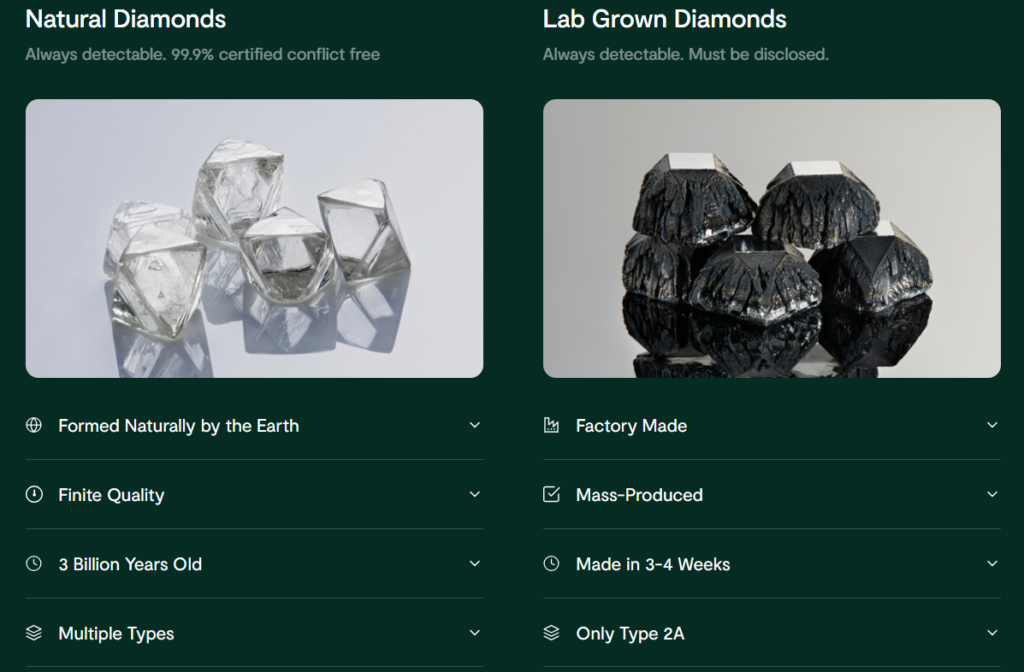
What is a lab grown diamond?
A laboratory grown diamond, also known as a synthetic diamond, lab created diamond, or man-made diamond, is a man-made gemstone that mimics the physical properties and optical properties of a natural diamond. Unlike natural diamonds, lab grown diamonds can be produced in unlimited quantities. Lab grown diamonds are created using advanced technologies such as High Pressure High Temperature (HPHT) or Chemical Vapor Deposition (CVD), which simulate the conditions under which natural diamonds form deep within the Earth’s mantle.
Do lab grown diamonds hold value?
Lab grown diamond prices have dropped significantly, from 80% of the cost of natural diamonds in 2016 to less than 20% by 2024. This dramatic price reduction is largely due to the ability to produce lab grown diamonds in unlimited quantities using methods like Chemical Vapor Deposition (CVD) and High Pressure High Temperature (HPHT). Unlike natural diamonds, which are rare, lab grown diamonds are priced based on production costs and retail markup. As production techniques improve and scale, their value is expected to continue declining until they reach a stable price point.
What is the actual value of natural diamonds?
Like other natural materials, how much natural diamonds cost is based on how rare they are to find in nature. The rarer the natural diamond, the more valuable it will be. Over the last 35 years, natural diamond prices have been shown to appreciate by approximately 3% annually. In its 2019 Global Diamond Industry Report, Bain & Co. found that the diamond market has grown thrice over the past 50 years.
How old are diamonds? Most natural diamonds are between 1 and 3 billion years old. Diamonds form deep within the Earth under intensely high temperatures and pressure, causing carbon atoms to crystallize before being transported to the Earth’s surface by powerful volcanic eruptions, such as kimberlite and lamproite eruptions. Although diamond formation occurs far beneath the Earth’s surface, these eruptions are rare yet immensely powerful, carrying diamonds from the Earth’s mantle to locations where they can be recovered.
These rare and precious gemstones are likely the oldest things you will ever touch, having formed long before any life existed on Earth. The oldest diamonds that have been dated, found in Canada, are 3.7 billion years old.
Are they rare and valuable?
The total amount of natural diamonds one carat and larger recovered in a year would only fill one exercise ball.
The value of a natural diamond derives from its rarity as a finite, natural gemstone. This rarity and finiteness make natural diamonds valuable. Over the last 50 years, natural diamonds have shown to appreciate in price by approximately 2-3% on average per annum. Natural diamonds retain inherent value over time, making them an incredible heirloom and an impactful choice for an engagement ring. However, like other manufactured products, man-made diamonds can be replicated in potentially unlimited quantities. Between 2015 and 2024, the prices of some lab grown diamonds fell by more than 80%.
Are lab grown diamonds unique?
Laboratory grown diamonds, often referred to as lab created diamonds, are not unique. These man-made diamonds are produced in controlled environments, allowing for large-scale production in unlimited quantities. Typically, they are created using two methods: High Pressure High Temperature (HPHT) and Chemical Vapor Deposition (CVD). These techniques replicate the natural processes that form natural diamonds deep within the Earth, but in a much shorter time frame.
Lab grown diamonds are manufactured to the exact specifications set by the producing company. While they share the same chemical composition and physical properties as natural diamonds, natural diamonds result from a truly incomparable journey. No two natural diamonds are alike, each one carrying its own history and story.
How are they created?
Natural diamonds are formed by the heat and pressure of the Earth, from 1 to 3 billion years ago, making a natural diamond the oldest thing you will ever touch.
Natural diamonds are formed deep within the Earth under intense heat and pressure, where pure carbon atoms crystallize into the hardest mineral on Earth, a diamond. The extreme conditions deep within the Earth that create natural diamonds are just the beginning of their journey. After forming about 100 miles below the Earth’s surface, natural diamonds were blasted upwards by ancient volcanoes. As these volcanoes erupted, they trapped the diamonds in molten rock, carrying them to the surface. Today, diamonds are found in the remnants of these ancient volcanoes, known as kimberlite pipes. Natural diamonds are often called “mined diamonds,” although some are recovered without traditional mining. These diamonds are made of pure carbon, formed under extreme pressure and heat over millions of years.
Unlike their natural counterparts, lab grown diamonds are created by humans using machinery and energy to force carbon to crystallize. Lab created diamonds are created using two primary methods: High Pressure High Temperature (HPHT) and Chemical Vapor Deposition (CVD). Although sharing physical properties and optical properties, lab grown diamonds’ quick growth process and different chemical compositions makes them easily identifiable from natural diamonds using a diamond tester. A reputable laboratory, such as the Gemological Institute of America (GIA), can also easily tell them apart using specialized instruments.
Do laboratory grown diamonds come with grading reports?
While some diamond grading laboratories do not certify laboratory grown diamonds, reputable organizations such as the Gemological Institute of America (GIA), the International Gemological Institute (IGI), and the Gemological Science International (GSI) provide detailed grading reports for lab grown diamonds. These reports clearly indicate that the diamond is laboratory grown, not natural. It’s crucial to be cautious of non-third-party grading reports that may fail to clearly disclose a diamond as lab grown.
Are all laboratory grown diamonds sustainable?
While laboratory grown diamonds are often marketed as eco-friendly, the reality is more complex. The energy-intensive process required to create these diamonds involves generating temperatures close to 20% of the temperature on the Sun’s surface, which demands significant energy consumption. Furthermore, much of the production takes place in countries like China and India, where coal is a dominant source of electricity. This means that, contrary to some claims, the environmental footprint of laboratory grown diamonds is far from negligible, as they are often powered by fossil fuels.
Diamond Facts #1
Is it possible to tell a laboratory-grown diamond from a natural diamond?
Yes! Because they are mass-produced, laboratory-grown diamonds have distinct growth patterns that are easily detected using professional verification instruments.
Diamond Facts #2
Are natural diamonds ethically sourced?
Established over 20 years ago by the United Nations and World Trade Organization, the Kimberley Process (KP) governs that rough diamond trade is strictly regulated to ensure it is conflict-free.
Over 80 countries participate, requiring transparency, export/import controls, third-party audits, and conflict free certificates for all shipments. They can only trade with other KP participants. You can be confident that your natural diamond is conflict free, ethically sourced, and comes from one of the most regulated industries in the world.
Diamond Facts #3
Are all laboratory-grown diamonds sustainable?
No! The energy-intensive process requires temperatures near 20% of the Sun’s surface heat. With most production in China and India, where coal powers the grid, a simplistic ‘green’ claim is not valid and is misleading.
Diamond Facts #4
How are laboratory-grown diamond prices trending?
Dropping! In less than a decade, the price of a 1.5-carat laboratory-grown diamond has dropped over 80% and continues to drop.
Diamond Facts #5
Are natural diamonds rare?
Yes! The annual global recovery of all natural diamonds 1 carat and above would fill just one exercise ball. The annual global recovery of 5-carat diamonds would only fit into one basketball
Diamond Facts #6
What is the natural diamond industry doing to reduce its carbon footprint and protect biodiversity?
The natural diamond industry is committed to decarbonize in line with global climate goals. Major diamond mining companies aim for carbon neutrality by 2030 and target net zero emissions by 2050.
Modern global diamond industry uses land that equates to the size of New York City and protects and conserves biodiversity over 4X this size.
Diamond Facts #7
Do natural diamonds benefit the countries they come from?
Yes! The natural diamond industry supports 10 million people worldwide. Up to 80% of rough diamond value stays within local communities through jobs, local purchasing, investment in infrastructure such as schools and hospitals, and social programs including free education and premier healthcare. In Botswana, it has enabled free education for all primary-age children, with enrollment rising from 100 pupils in 1996 to 89,856 in 2022.
Diamond Facts #8
How do I know whether I’m purchasing a natural or a laboratory-grown diamond?
Disclosure and Diamond Grading Reports! Sellers are mandated to disclose what type of diamond they are selling. Diamond reports must clearly classify whether the diamond is a laboratory-grown or a natural diamond.
Note: The word ‘diamond’ on its own always refers to natural diamonds.
Diamond Facts #9
Is it true the industry stockpiles diamonds to drive-up prices?
No! Inventories of natural diamond producers fluctuate because, unlike other industries, the recovery of this precious and finite natural resource is such that it cannot automatically adjust to match supply with demand.
Diamond Facts #10
Is it true the conditions for the workforce in the natural diamond industry are poor and unsafe?
No! The major diamond mining companies adhere to top global standards, hiring 99% locally, with women making up one-third of the workforce. Employees earn 6x above thier natural averages and receive premium healthcare, education, and other important wellbeing benefits.
Large-scale, modern operations prioritize safety first, with incident rates far below other sectors such as retail and other comparable mining operations.
Diamond Facts #11
Are natural diamonds traceable?
Yes! The natural diamond industry is advanced in traceability initiatives, using blockchain and other cutting-edge technologies to bring transparency to its supply chains.